Thursday, January 28, 2021

Mt. Paul Monastery

This small mountaintop monastery was established in 1924. The order of Paulists paid $50,000 for 1200 acres of land in the Oak Ridge section of Jefferson. They constructed a small seminary building with a chapel alongside the twelve acre pond on the property. 

The small structure wouldn't last for long. A 30,000sf building was constructed around 1960 with a chapel, gymnasium, and dormitory space next to the original building. The old structure was subsequently demolished.


By 1997 the seminary was closed, but the building continued to be used as a retreat, similar to the St. Paul Monastery in nearby Newton.

Citing roughly $200,000 in yearly upkeep expenses, the Paulists planned to close the retreat at Mt. Paul in 2009. The land was sold to the state for $12 million, which was paid out of the NJ Open Space Trust. The bodies were moved from the cemetary on the property to a nearby catholic cemetary. By June of the following year, the Paulists officially left the property.

For nearly a decade the building remained mostly vacant. When we visited the structure it still had running water and lights on even though the building was completely unattended. There were several smashed windows and other signs that people had been aware that the building was left with no security in the middle of the woods. 

Thankfully before the damage got too bad, Kean University stepped in and purchased 40 acres of the property. They renovated the main building while demolishing the caretakers home from the 1920s. The campus is now called "Kean Skylands", and offers a number of unique amenities that honor the character of the land. Hopefully the building will survive under their stewardship for many more decades to come.


Wednesday, January 20, 2021

St Bridget's Church

Source

The Parish was founded 1869. However. It wasn't until 1882 that construction began on the current church. It took eight years to complete, and in 1890 parishioners filled the pews. The structure was designed by Patrick Charles Keeley, the premier Roman Catholic church architect in North America.

St. Bridgets had a long, albeit uneventful history. In 1997 the archdiocese merged 4 other parishes into the St. Bridgets Parish; St Peters, St Boniface, St Marys and St Michaels. Bridget's was left a worship site, rarely being used over the next two decades. The building recieved a facelift in 2011, but unfortunately it wouldn't stave off its inevitable closure. The convent, school, and rectory were converted into housing in 2014. The church building was listed for sale, and was used to host flea markets and other ceremonies from 2014 to 2017. I even attended one of the flea markets, marveling the entire time at the gorgeous building it was set in. However, the structure was converted to apartments in 2019.

The crew got right to work stripping out the balcony and gutting the plaster from the nave. They tore up the hardwood floor, leaving very little of the original interior undisturbed. Renderings for the apartment spaces show vaulted plaster ceilings in some of the units, which actually look quite nice. Hopefully the nearby St Lucy's Church will recieve a similar treatment, as it is also due to be renovated in the coming months. Only time will tell.


Mountainside Hospital School of Nursing

Mountainside Hospital has been my local hospital my entire life. The large hospital building has several wings of different architectural styles, some dating back a century or more. This article is not about the hospital however. Instead, I will be focusing on the school building that was constructed across Bay Street.

The Mountainside Hospital School of Nursing was established in 1892, just one year after Mountainside Hospital opened its doors. This made the school one of the oldest in the state. York and Sawyer completed a new wing of the hospital in 1923. I believe this is around the time the largest portion of the Student Nurses Building was constructed, leading me to believe this building was also drafted by the pair. 

In 1966 a new wing was added to the right side of the existing building. This was the last major building upgrade the school would see. In 2009 it was announced that the school was not accepting any more applications, much to everyone's surprise.

Two years later the school merged with a program at Caldwell College, The class of 2011 was the last group of students to graduate, and the building was left mostly vacant. A few years later, while at the hospital as a visitor, I decided to take a shortcut to get back to my car. I discovered a back door had been left ajar, so I took a quick poke around the building.

I was surprised how much medical equipment had been left in the former school. It was almost as if the school building was a small hospital itself. The power was on, but the local police had been training inside and had made a huge mess of the place. They wrote all over the walls, smashed asbestos containing doors open, all the damage one might expect after being used to roleplay the pseudo-military fantasies of law enforcement.


I only visited the building once more before it was announced that demolition was set to begin in 2018. As fate would have it I also needed to have some emergency surgery at the same time, and my room overlooked the demolition site. I spent time over the span of several watching the crews rip apart the structure, feeling glad that I had the opportunity to document it.

Finally by January 2020 a new building opened on the site of the old school. Passing by now one would not even realize such a handsome structure ever graced the land. Hopefully this post serves as a decent reminder of what once was.


Thursday, January 7, 2021

The Union Waxed Paper Mill

One of the most iconic abandoned locations in New Jersey has to be the old Wheatsworth Mill building. However, few people know that behind the Wheatsworth complex along the old NJ Midland Railroad lies another piece of Hamburg's industrial past; the old Union Waxed and Parchment Paper Mill.

Source: TFPNJ Historic Postcard Collection

What is now little more than a collection of crumbling ruins along the Walkill River was once a bustling paper producer. Paper production had historically been one of New Jersey's lesser know big industries. Most only know of Marcal, which tragically burned down in 2019. However there also existed large paper mills in Milford, Warren Glen, and Hughesville. Before any of these were operating, there was the Hamburg Paper Mill. 

The facility was constructed in 1874. At the time there existed a dam on the river for the iron furnace on the site, which was another popular industry in the state at the time. The dam was raised in order to be able to increase its power potential.

Unfortunately the land on which the mill say on was flood prone, causing issues for production. Ironically it was a series of fires that eventually put the mill out of production in the 1950s. Shortly afterwards the train line that runs alongside the mill was de-tracked and subsequently abandoned. 

The mill was left to rot, and after decades of neglect very little remains of the complex. What is left, however, is quite a sight to behold. 


Solomon Bell House

.

One of the most recognizable houses of old Walpack fame is the old Solomon Bell house. The home was once situated on Mountain Road just outside Walpack Center. The land on which the house was built was owned by John and Anna Symmes, parents to the bride of former president Willaim Henry Harrison. Anna Symmes is interred at Walpack cemetary, near where the home used to stand.

Solomon Bell built the home around 1820. The Bell family was well known in Walpack, having been there since around 1700. The Gordon family also occupied the house at some point in its history. The patriarch of the Gordon family was one of the men who founded the Walpack fire department.


The entire town of Walpack and several other towns were left vacant after the Army Corp of Engineers proposed a new dam be built along the Delaware River. A similar project created the Round Valley Reservoir, which readers of this blog may recognize from my write up on the Long Pond Ironworks. The Tocks Island Dam Project never came to fruition, leaving dozens and dozens of historic buildings vacant. Unfortunately with nobody left to care for the home it fell into severe disrepair. Several small fires occurred over the years, and vandals smashed out all the windows and punched holes in the walls. I only had a chance to visit the home once around 2009. Eventually the building was declared a nuisance, and was demolished in 2011.


Since the home was demolished many others in town have fallen victim to arson and other forms of vandalism. The National Park Service has no funds to maintain the structures, and very few if any attempts have been made to secure any of the buildings over the years. Only time will tell what will happen to the rest of the historic Walpack structures.

Sunday, January 3, 2021

American Cyanamid

Source

The land in which the American Cyanamid was constructed was originally known as "Clarksville". The small farming community existed so far back that it predates the American Revolution. George Washington is said to have marched through Clarksville after departing Trenton in 1777. As centuries passed, the landscape of what was once Clarksville remained relatively unchanged. That is, until the 1960s.


The American Cyanamid corporation was formed in 1950. A decade later the company broke ground on what would become their new research facility on what was once Clarksville farmland. At the time the complex was just a few small buildings and a couple greenhouses. 


Throughout the decades the building complex expanded to cover nearly 700 acres. The structures were on both sides of Clarksville road. By now the land that the road was named for was completely indistinguishable from the farmland it once was.


In 1994 American Home Products merged with American Cyanamid, creating the ACC Agricultural Division. It was around this time that chemicals were discovered to be leeching into the groundwater from one of the companies landfills. Landfill #2 mostly consisted of lab glass and labratory waste. In 1995 the site was excavated to prevent further contamination.


Five years later BASF, a German based chemical producer, purchases the labratory from American Home Products. However AHP retained ownership of land until the contamination was dealt with. Two years after the sale, American Home Products Becomes Wyeth Corporation.


The Rouse Corporation purchased property for $35 million in 2004. Two months later General Growth Corporation purchases Rouse. It was around this time that manufacturing and research ceased at the property, leaving the complex vacant.


In 2009, Rouse declared bankrupcy after several failed attempts to develop site. Rouse restructured and came out of bankrupcy shortly afterwards. They formed the Howard Hughes Corporation to shelter non-core assets. Once again, several devopment proposals were pitched for the site, and all were denied. HHC held onto the property until 2019, when it was sold to Atlantic Realty.


The facility had been languishing for nearly 15 years before I had a chance to visit. I was blown away with how well the buildings held up to the elements. At the time almost nobody knew the place existed, so I was one of the first people to visit to document it. A few years later the place made it onto public Instagram accounts, which we all know is a death sentence for any location. 


Soon visitors were coming to smash and steal whatever they could. They started breaking windows and skylights, allowing water to infiltrate the once-pristene buildings. I'm glad I was able to visit when I did, so readers of this blog can see what the location looked like before the trash visited. 


The property will inevitably be demolished and developed, its only a matter of time. Its unfortunate others had to be so self aggrandizing, but that's just the nature of insecurity. Its not the first local location ruined by Instagram, and it certainly won't be the last.


Manunka Chunk Tunnels

Source

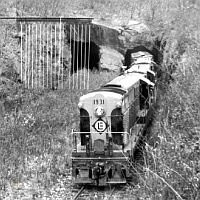
It was 1856 when John Blair opened the "Warren Railraod" that cut across Warren County before crossing over the Delaware River. The line had two tunnels and a number of bridges. Construction on the Manunka Chunk tunnel took just two years. The swift completion of the 938 foot long tunnel was a result of the soft shale composition of the rock. By comparison, construction on the Oxford Tunnel to the south took 8 years. 

By 1869 a second bore was opened and the line was double tracked. The completion of the second bore also only took 2 years. The Pennsylvania Railroad's Belvidere and Delaware Division joined the Delaware, Lackawanna and Western line at Manunka Chunk, though only the DL&W used the tunnels. The DL&W connected Hoboken to Buffalo, NY. The "BelDel" ran from Trenton and ended at Manunka Chunk.

In 1876 the two railroad companies joined forces and built both a passenger and freight station, as well as a signal tower. The popularity of the passage was short lived however. By 1911 the Lackawanna cut off opened to the north, diverting traffic away from the DL&W rail line. Two years later a heavy rain storm washed out many rail lines in the area, including the lines at Manunka Chunk. The ensuing flood obliterated the station and knocked over the tower. The structures were never rebuilt.

Source


Tracks were removed from the eastbound side of the tunnel in 1948 due to lack of traffic on the line. Passenger service had been discontinued by this point, and the line was only used for freight. 

Source

By the mid to late 1960s more flooding had caused the tunnels to become underutilized. The line was officially abandoned in the 1970s, and the tunnels have sat crumbling ever since.

A number of collapses have all but assured that the passageway will never see rail service again.