Showing posts with label Railroad Infrastructure. Show all posts

Sunday, January 3, 2021

Manunka Chunk Tunnels

Source

It was 1856 when John Blair opened the "Warren Railraod" that cut across Warren County before crossing over the Delaware River. The line had two tunnels and a number of bridges. Construction on the Manunka Chunk tunnel took just two years. The swift completion of the 938 foot long tunnel was a result of the soft shale composition of the rock. By comparison, construction on the Oxford Tunnel to the south took 8 years. 

By 1869 a second bore was opened and the line was double tracked. The completion of the second bore also only took 2 years. The Pennsylvania Railroad's Belvidere and Delaware Division joined the Delaware, Lackawanna and Western line at Manunka Chunk, though only the DL&W used the tunnels. The DL&W connected Hoboken to Buffalo, NY. The "BelDel" ran from Trenton and ended at Manunka Chunk.

In 1876 the two railroad companies joined forces and built both a passenger and freight station, as well as a signal tower. The popularity of the passage was short lived however. By 1911 the Lackawanna cut off opened to the north, diverting traffic away from the DL&W rail line. Two years later a heavy rain storm washed out many rail lines in the area, including the lines at Manunka Chunk. The ensuing flood obliterated the station and knocked over the tower. The structures were never rebuilt.

Source


Tracks were removed from the eastbound side of the tunnel in 1948 due to lack of traffic on the line. Passenger service had been discontinued by this point, and the line was only used for freight. 
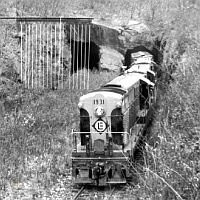
Source

By the mid to late 1960s more flooding had caused the tunnels to become underutilized. The line was officially abandoned in the 1970s, and the tunnels have sat crumbling ever since.

A number of collapses have all but assured that the passageway will never see rail service again. 


Tuesday, February 11, 2020

The Port Reading McMyler Coal Dumper

Port Reading is a small unincorporated community in Middlesex County. Though technically part of Woodbridge, Port Reading was given the name as it was founded expressly for the needs of the the Reading Railroad. The port was tied to the main Reading artery by a line called the Port Reading Railroad which opened in 1892. Several unique historical features distinguish the region from the rest of Woodbridge. One such piece of history is the McMyler Coal Dumper, one of the most impressive industrial advances of the time.

Source

The McMyler Coal Dumper was invented in 1917 by the McMyler Interstate Company of Bedford, Ohio. The system relied on a combination of gravity, heavy machinery, and manpower. Full coal cars would ride up the track and come to a full stop. A "pig block" would catch the car underneath and bring it up a ramp.The McMyler would use a system of cables and platforms to lift and turn the car on its side to dump the contents into an metal arm which extended over a barge in the water below. Men on the barge would then work to distribute the coal evenly to prevent the water vessel from flipping. When the car was empty it was turned back over, where if successful it would leave the Dumper, ascend a steep grade, switch tracks, and leave on an exit track. With everything running smoothly the dumper could unload a full car every two and a half minutes. This complicated system can be seen in this video, filmed by a rail fan who built his own model McMyler.


One such dumper was erected in Port Reading the same year, making it one of the first put into service. The region had a huge demand for coal, as that was the most widely used fuel for generating stations and industrial facilities throughout the northeast. McMyler dumpers popped up in South Amboy, Perth Amboy, and Jersey City, shuffling tons of Appalachian coal from train to barge for decades.


In 1951 a large fire damaged the Port Reading McMyler. The machinery was pulled from the water, and rebuilt using the salvaged remains of one of the many other dumpers in the region. The newly rebuilt Port Reading McMyler continued to churn out coal until 1982. Coal had been falling out of favor due to its inefficiency and the toll it took on the environment. As power generation got more advanced, the massive old coal dumpers were rendered useless.


The site was listed by Preservation New Jersey as one of the top ten endangered historic sites in the state in 2004. Despite this the property was still abandoned, and nothing was done to stabilize the dumper. When hurricane Irene hit in 2011 she caused significant further damage. The cables holding the coal chute failed, and the entire arm fell into the river. A few years later the property was sold to a redevelopment company. They built a parking lot over the former dumpers spur, forever bisecting the McMyler from the rest of the Port Reading line, now owned by Conrail. The company that bought the land has kept an open mind towards the preservation of this crumbling piece of history. Unfortunately, given the condition it's in, its only a matter of time before it ones again sinks into the river again as it did in 1951. The next time it happens there will certainly be no rebuilding it. The Port Reading McMyler is the last of its kind anywhere in the region, and one of only a handful left anywhere in the world. If you want to go take a look, the time to visit is now.


Thursday, February 6, 2020

Fairview/Edgewater Tunnel

One of my favorite ways to spend spare time is by using aerial imagery to trace old railroad lines as they make their way across the country. New Jersey has hundreds of miles of abandoned right of way, stretching out across the landscape of the state like a network of veins. While following the Edgewater spur of the New York, Susquehanna & Western Railway the line seems to disappear into a valley at the Fairview Cemetery. This is where the Fairview Edgwater Tunnel begins.


Construction for the subterranean passage wrapped up in 1894. Most of the span is natural stone, with brick arches at regular intervals. The mouth of the west portal is also bare stone, but is lined with concrete. The east portal has a more decorative concrete face.


The tunnel featured two portals and a single brick vent. The vent can still be seen today, looking very out of place among the houses that surround it.


The tunnel vent as seen from Google Earth.

The mile long corridor was in service for nearly a century, but eventually fell out of use. The tracks along the right of way were removed in the early 1990s, and the line was abandoned. The tunnel itself is still technically used, though not by any rail service. A natural gas line as well as a power line still run through the corridor. The natural decay has begun to take a toll on the utilities. Large chunks of rock have chipped of the walls and ceiling, occasionally landing on the lines.


There has been talk of reviving the abandoned line for light rail service, and while these notions haven't been put into place they also haven't been dismissed. For this to happen there would need to be significant repair work done on the tunnel, as the years of disuse have caused severe degradation and have brought the structural integrity of the tube into question.


I hope somebody steps in and finds a more practical use for the Fairview Tunnel soon. Its only a matter of time before the portals get sealed off and the tunnel demolishes itself.